
Statutory Holidays Ontario 2025: Dates, Pay Rules, and Real-World Guidance
Planning around statutory holidays in Ontario for 2025 is more than just circling long weekends. If you manage payroll or schedules, you’re juggling public holiday pay rules and staffing needs. If you’re an employee, you want to know what you’re owed and when you can actually take the day off. This in-depth guide brings clarity to statutory holidays Ontario 2025—covering exact dates, who qualifies for public holiday pay, how to calculate it correctly, your options if you work on the holiday, and the special rules that trip people up. You’ll also find practical planning tips for long weekends, industry-specific notes for retail and hospitality, and a concise FAQ at the end.
By the time you finish, you’ll know the 2025 calendar cold, understand Ontario’s Employment Standards Act (ESA) rules in plain English, and have examples you can use straight away—no guesswork, no fluff, and no nasty surprises at payroll time.
Ontario’s 2025 Public (Statutory) Holidays at a Glance
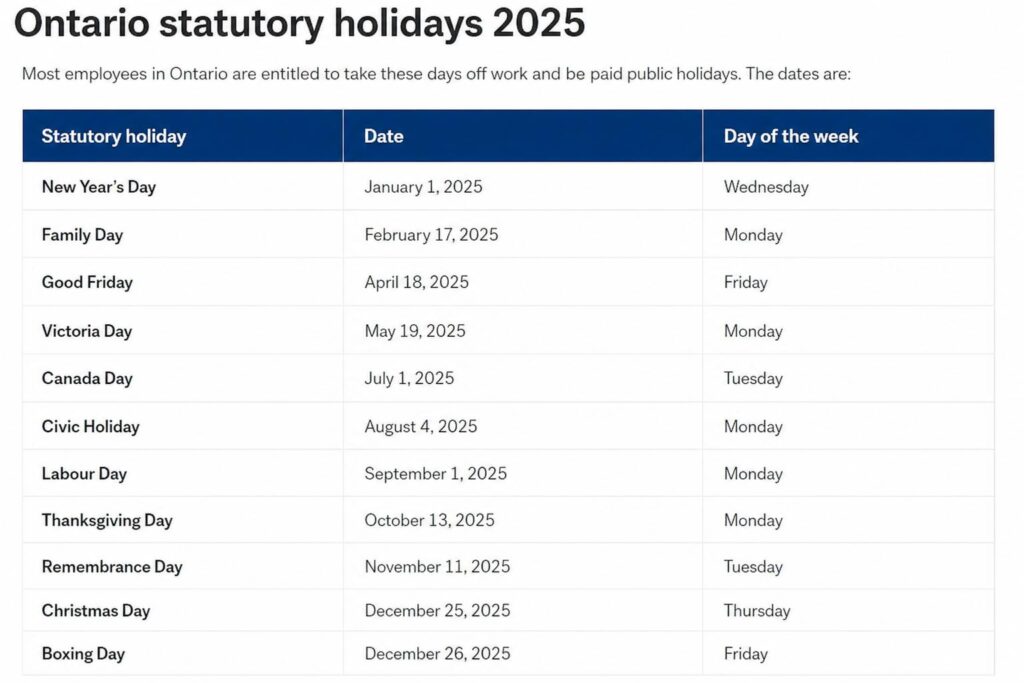
Ontario recognizes nine public holidays under the ESA. These are often called “stat holidays.” Below are the 2025 dates, with notes on closures and quirks that matter for planning. All dates are specific to Ontario’s ESA, which applies to most provincially regulated workplaces in the province.
| Holiday | 2025 Date | Day of Week | ESA Public Holiday? | Notes |
|---|---|---|---|---|
| New Year’s Day | January 1, 2025 | Wednesday | Yes | Start of year closures are common; many retail stores closed under retail holiday rules. |
| Family Day | February 17, 2025 | Monday | Yes | Mid-winter long weekend. Schools, many offices closed. |
| Good Friday | April 18, 2025 | Friday | Yes | Part of the Easter weekend. Many retailers closed; transit often on holiday schedules. |
| Victoria Day | May 19, 2025 | Monday | Yes | Traditional “start of cottage season.” Fireworks bylaws vary by municipality. |
| Canada Day | July 1, 2025 | Tuesday | Yes | Mid-week stat. Many regional festivities; liquor and cannabis retail hours vary by local rules. |
| Labour Day | September 1, 2025 | Monday | Yes | Back-to-school week. Almost all retail malls close under retail holiday legislation. |
| Thanksgiving Day | October 13, 2025 | Monday | Yes | Fall long weekend. Grocery stores in many cities are closed. |
| Christmas Day | December 25, 2025 | Thursday | Yes | Essential services only. Retail closure rules are strict. |
| Boxing Day | December 26, 2025 | Friday | Yes | Ontario-only quirk as a stat holiday. Many retailers open for sales, but hours vary. |
Important distinctions for 2025:
- Easter Monday (April 21, 2025) is not an ESA public holiday in Ontario, though many banks and government offices close.
- Civic Holiday (Monday, August 4, 2025) is a widely observed municipal holiday but not an ESA public holiday. Many employers offer it as a paid day off by policy or contract—check yours.
- National Day for Truth and Reconciliation (September 30, 2025) is not an ESA public holiday in Ontario. It is observed as a general holiday for federally regulated employees under the Canada Labour Code and is widely recognized by public sector institutions.
- Remembrance Day (November 11, 2025) is not an ESA public holiday in Ontario. Many workplaces hold observances at 11 a.m.; some retail businesses pause operations for a moment of silence.
What “Statutory Holiday” Means in Ontario (and What It Doesn’t)
When people say “statutory holiday,” they often lump together different types of days off. Ontario’s Employment Standards Act is the law that sets the minimum standards for public holidays for most provincially regulated workplaces. If you work in Ontario for a provincially regulated employer, these ESA rules likely apply to you—whether you’re full-time, part-time, temporary, or on commission.
That’s different from:
- Federal general holidays under the Canada Labour Code (CLC), which apply to federally regulated sectors like banks, airlines, interprovincial transportation, and telecom. Their holiday list differs and includes the National Day for Truth and Reconciliation. Many federal workplaces also close for Easter Monday by policy.
- Municipal or “civic” holidays (for example, the first Monday in August). These are not ESA public holidays, though many employers provide them as paid days off. Municipal bylaws also affect what stores can open.
- Retail closure rules. The Retail Business Holidays Act (RBHA) in Ontario requires many retail stores to close on certain days, including New Year’s Day, Good Friday, Easter Sunday, Canada Day, Labour Day, Thanksgiving Day, and Christmas Day, with exemptions (small stores, pharmacies, tourist areas, gas stations, etc.). This is separate from whether employees are entitled to public holiday pay under the ESA.
Bottom line: “Is it a stat?” (ESA entitlement) and “Is the mall open?” (RBHA closures) are related but not the same question.
The 2025 Calendar: Long Weekends, Mid-Week Breaks, and Planning Tips
Holiday dates only tell part of the story. The rhythm of 2025 creates different challenges—mid-week breaks that complicate scheduling, and classic three-day weekends where everyone wants the Friday off. Here’s what the year looks like in practical terms.
Winter Reset: New Year’s Day and Family Day
New Year’s Day lands on a Wednesday. Many workplaces kick off the year on January 2, but construction, healthcare, hospitality, and transit run through the holiday. If you’re scheduling essential operations, decide early whether you’ll offer a substitute day or premium pay for anyone working January 1—get it in writing and record it for payroll compliance.
Family Day (Monday, February 17) is the first true long weekend of 2025. Expect ski hills, indoor waterparks in Niagara and Muskoka, and Ottawa’s Winterlude to be busy. If you’re an employee planning a mini-break, lock in accommodations early and double-check your accrual balances if your employer combines public holidays with floating days for scheduling flexibility.
Spring Breaks: Good Friday and Easter Monday
Good Friday (April 18) is an ESA public holiday. Easter Monday (April 21) isn’t—though many banks and public institutions close. Your kids might be off school while you’re not. If you’re a manager, communicate staffing needs well in advance; if you’re an employee, confirm whether Easter Monday is paid or unpaid in your contract or policy manual.
First Cottage Run: Victoria Day
Victoria Day falls on Monday, May 19. Outside the GTA, traffic tends to spike Friday afternoon as cottage country wakes up. Municipal fireworks rules differ—some allow fireworks only on the holiday and the day before; fines can be steep. If your business sees seasonal demand (garden centres, hardware, marinas), map staffing to weather forecasts—sunny long weekends drive walk-in traffic; rainy ones don’t.
Canada Day in the Middle of the Week
Canada Day is Tuesday, July 1 in 2025. It’s not a long weekend by default, but many employees will ask for Monday, June 30 off. If you grant it broadly, you effectively create a four-day break (June 28–July 1). From a staffing point of view, start collecting time-off requests in May and apply a transparent system (seniority, rotating first-come-first-served, or a cap per department) to keep things fair.
Peak Summer: Civic Holiday (Not a Stat) and Labour Day
The Civic Holiday (Monday, August 4) is not an ESA public holiday. Many employers still close, especially municipal services and offices. Check your collective agreement or policy—if it’s paid, treat it like any other employer-paid holiday for scheduling purposes.
Labour Day (Monday, September 1) is the last warm-weather long weekend and a true ESA public holiday. Many malls close under retail legislation. Expect family events, parades, and back-to-school prep. If you’re in retail or hospitality, plan for high demand Saturday–Sunday with minimal staffing Monday if closures apply.
Fall Colours: Thanksgiving
Thanksgiving (Monday, October 13) is prime time for Ontario’s fall foliage. Provincial parks, Niagara wineries, and farm markets are busy. If you run a seasonal business, this is a last hurrah; if you’re a city employer, it’s a quieter stretch before the holiday season ramp-up.
The Holiday Stretch: Christmas and Boxing Day
Christmas (Thursday, December 25) and Boxing Day (Friday, December 26) create a natural four-day weekend. Many employers shut down for the week or run skeleton crews. Shipping lead times and supplier closures matter—build buffers into December project plans and move payroll processing deadlines forward so deposits land before the holidays.
Who Is Entitled to Public Holiday Pay in Ontario?
Under the ESA, most employees in Ontario are entitled to take ESA public holidays off work and be paid public holiday pay. That includes full-time, part-time, casual, temporary, and commission-based employees. There is no minimum service requirement—new hires can qualify, though their pay may be low if they have little prior earnings.
The “Last and First” Rule (and Reasonable Cause)
To keep entitlement for a particular holiday, an employee must not, without reasonable cause:
- Fail to work their last scheduled day of work before the public holiday, and
- Fail to work their first scheduled day of work after the public holiday, and
- Fail to work on the public holiday if they had agreed or were required to work that day.
Reasonable cause can include things like a verified illness, an emergency, or another legitimate reason beyond the employee’s control. If an employee calls in sick for the day before the holiday and doesn’t have reasonable cause (or misuses the absence), they can lose entitlement to public holiday pay for that holiday.
Industries with Special Rules or Exemptions
Some industries and roles have special rules or are partly exempt from public holiday provisions—examples include certain construction jobs, hospitality (hotels, tourist resorts, restaurants), healthcare, and employers that operate continuous processes (like certain manufacturing). These workplaces may have different options for substituting public holidays or requiring work on the day, provided minimum ESA standards are met. If you’re in a sector with 24/7 operations, check the ESA special rule regulations or your collective agreement.
Unionized Workplaces
Collective agreements often set detailed holiday provisions. They must meet or exceed ESA minimums, but they can structure entitlements differently (for example, automatic lieu days, fixed premiums, or extra holidays). If your collective agreement contains public holiday language that differs from ESA default rules—but provides at least equivalent overall benefits—it generally governs.
How to Calculate Public Holiday Pay in Ontario (2025)
Ontario uses a clear formula under the ESA. For each ESA public holiday, public holiday pay equals:
(Total regular wages earned in the four work weeks before the work week that includes the public holiday + vacation pay payable on those wages) ÷ 20.
Plain-English notes:
- “Regular wages” exclude overtime pay, premium pay, termination or severance pay, and public holiday pay itself. Commissions and non-overtime bonuses tied to work performed generally count as wages, but confirm with your payroll provider if you have complex incentive plans.
- “Work week” is the 7-day period your employer uses for scheduling and record-keeping (it might not be Sunday–Saturday).
- “÷ 20” is fixed—even if the employee works fewer than 20 days in those four work weeks. That’s why very new or sporadically scheduled employees may receive a small amount.
Example 1: Full-Time Hourly Employee
Employee earns $20/hour, works 40 hours each week. In the four work weeks before the holiday, they earned $3,200 in regular wages and no vacation pay is payable on those wages (assuming vacation is accrued but not paid out during that period).
Public holiday pay = $3,200 ÷ 20 = $160.
If the holiday is taken off, they’re paid $160 for the day off (regardless of their usual daily hours). If they work the holiday, the compensation depends on the option used (see “Working on a statutory holiday” below).
Example 2: Salaried Employee
Employee earns $1,000 per week salary. Four work weeks before the holiday = $4,000 in regular wages. No vacation pay is payable on those wages.
Public holiday pay = $4,000 ÷ 20 = $200.
Example 3: Part-Time Employee with Irregular Hours
Employee works 12 hours in total over the four weeks before the holiday at $18/hour, and receives vacation pay of 4% along with each pay.
Regular wages earned = 12 × $18 = $216. Vacation pay payable on those wages = 4% × $216 = $8.64. Total = $224.64.
Public holiday pay = $224.64 ÷ 20 = $11.23.
Example 4: Commission-Only Sales
Employee earns $1,500 in commissions in the four work weeks before the holiday; no overtime or premium pay components. Vacation pay is accrued at 6% and payable with each pay.
Total wages = $1,500. Vacation pay payable = 6% × $1,500 = $90. Total = $1,590.
Public holiday pay = $1,590 ÷ 20 = $79.50.
Example 5: Recently Hired Employee
Employee starts two weeks before the holiday and earns $400 in regular wages before the holiday, with 4% vacation pay payable on those wages.
Total = $400 + $16 = $416. Public holiday pay = $416 ÷ 20 = $20.80.
New hires don’t need to “wait” for entitlement; the calculation simply reflects their recent earnings.
What if Vacation Pay Is Paid Later?
The formula uses vacation pay “payable” on the wages from the prior four work weeks. If your policy pays out vacation later, but it is legally “payable” on the wages earned in that period, it still factors into the calculation. When in doubt, check your vacation policy and the ESA Guide, or ask your payroll provider to configure holiday pay correctly.
Working on a Statutory Holiday: Your Options
Sometimes work can’t stop—think hospitals, hotels, restaurants, transit, and some manufacturing. When an employee who’s entitled to the public holiday works on it, Ontario provides two main compensation structures. One is the default if you don’t have a written agreement; the other requires agreement in writing.
Option A (Default Without Written Agreement): Regular Wages + Substitute Holiday
If an entitled employee works on the public holiday and there’s no written agreement to do otherwise, the default is:
- Pay regular wages for all hours worked on the public holiday (no 1.5x premium), and
- Provide a substitute day off (a “lieu day”) with public holiday pay.
The substitute day must be scheduled within a reasonable time. Employers should document the date chosen and the amount of public holiday pay applied to that lieu day for compliance.
Option B (By Written Agreement): Premium Pay + Keep the Holiday Pay (No Lieu Day)
By written agreement between the employer and the employee, an entitled employee who works on the public holiday can instead receive:
- Premium pay of at least 1.5 times the employee’s regular rate for all hours worked on the public holiday, and
- Public holiday pay for the holiday, with no substitute day off.
This approach is popular in sectors where employees prefer extra money over a day off later. The key is the written agreement—verbal understandings aren’t enough.
If an Employee Is Not Entitled for That Holiday
If the employee failed the “last and first” requirement without reasonable cause (or failed to work the holiday shift they agreed or were required to work), they lose entitlement for that holiday. If they still work on the holiday, they’re generally paid their regular rate for hours worked, with no public holiday pay and no lieu day.
How Public Holiday Hours Interact with Overtime
Here’s a nuance payroll often misses:
- If an employee is paid premium pay (1.5x) for hours worked on the public holiday, those hours do not count when determining whether the employee has worked overtime hours for the week.
- If an employee is paid regular wages for hours worked on the public holiday and receives a substitute day off (Option A default), those hours do count toward overtime threshold calculations for that week.
In a week where you’re close to 44 hours, whether you use premium pay or regular pay plus a lieu day can change whether overtime kicks in. Choose and document the option intentionally.
If the Statutory Holiday Falls During Vacation or a Leave
Life doesn’t schedule itself around the calendar, so here’s what happens when holidays and leaves collide.
Holiday During Vacation
If an ESA public holiday occurs during an employee’s vacation, the employee is entitled to either:
- A substitute day off with public holiday pay, or
- Public holiday pay for the holiday (depending on what’s agreed, consistent with ESA rules).
In short, employees don’t “lose” an ESA public holiday just because they’re on vacation that day. Employers should track the substitute day clearly and apply the public holiday pay formula.
Holiday During ESA-Protected Leave
If an employee is on an ESA-protected leave (for example, pregnancy/parental leave, family responsibility leave, declared emergency leave), their entitlements are governed by ESA leave rules. Generally, employees on unpaid ESA leaves do not receive wages during the leave, including public holiday pay for holidays that occur while they’re on leave. When they return, they resume normal entitlements. If your workplace provides top-ups or paid leaves by policy, check how those interact with holidays.
Sick or Personal Emergency the Day Before or After
If an employee misses the last scheduled shift before or the first scheduled shift after the holiday due to illness or emergency, they maintain entitlement if they had reasonable cause. Employers can ask for reasonable evidence, but there are limits on requesting medical notes in some contexts—review current guidance and your policies before demanding documentation.
Retail, Hospitality, and 24/7 Operations: Special Considerations
Public holiday entitlements are one layer. Operating legally on the holiday is another.
Retail Business Holidays Act (RBHA) Closures
In Ontario, many retail stores must close on certain holidays (for example, New Year’s Day, Good Friday, Easter Sunday, Canada Day, Labour Day, Thanksgiving Day, and Christmas Day), subject to numerous exemptions:
- Small stores below a specified size with limited staff
- Pharmacies under a certain square footage
- Gas stations, convenience stores
- Tourist area exemptions (by municipal bylaw)
The RBHA is complex and enforced by municipalities. It’s separate from ESA public holiday pay. A store that’s legally allowed to open must still pay employees according to ESA holiday rules if they are entitled. If in doubt, check your municipality’s bylaws and consult the provincial guidance.
Hospitality and Tourism
Hotels, restaurants, and tourist resorts usually operate 365 days a year. ESA special rules can allow different substitution practices for public holidays in continuous operations. That said, the minimums still apply: entitled employees either get public holiday pay plus premium pay with no lieu day (if agreed in writing), or regular pay for the day worked and a substitute day with public holiday pay. Scheduling early and getting written agreements in place reduces friction during peak travel weekends.
Continuous Operations and Manufacturing
Workplaces that run around the clock—certain manufacturing plants, utilities, and processing facilities—must plan in cycles. A published rotation (A/B crews, for instance) should state in advance whether employees working the holiday receive premium pay with the holiday pay or regular pay with a scheduled lieu day, and when the lieu day will occur. Transparency is your ally; surprises are not.
HR and Payroll Best Practices for Statutory Holidays in 2025
Having the right policy and records makes ESA compliance straightforward and keeps trust high with your team. Here’s a practical playbook.
Put Holiday Options in Writing
For employees who may work public holidays, draft a short written agreement template covering:
- Whether the default is Option A (regular wages + substitute day with public holiday pay) or Option B (premium pay + public holiday pay, no substitute day)
- How substitute days will be scheduled and documented
- How overtime interacts with holiday pay choices
Have employees sign off before the busy season. Keep a copy with payroll records.
Use the ESA Formula Consistently
Configure your payroll system to use the ESA formula (prior four work weeks’ regular wages plus vacation pay payable ÷ 20) for each public holiday. For employees with variable pay, ensure the system picks up all eligible wage types and the correct vacation pay percentage. Test the setup before Family Day to catch issues early.
Audit “Last and First” Entitlements
Before processing holiday pay, verify who maintained entitlement (worked last scheduled day before and first scheduled day after, or had reasonable cause). Document your review—especially for employees who were absent—so you can explain any exceptions if asked later by the Ministry or the employee.
Keep Records for at Least Three Years
Under the ESA, employers must keep payroll and holiday-related records (including written agreements for working on public holidays, substitute days taken, and how public holiday pay was calculated) for a minimum period—commonly three years. Organized records can save time in an inspection and prevent costly mistakes.
Communicate Early, Especially for Mid-Week Holidays
Canada Day 2025 occurs on a Tuesday. Decide by late spring whether you’ll offer flexibility on Monday, June 30, and how requests will be handled. Clear, early communication reduces last-minute scrambling and resentment.
Comparing Ontario ESA Holidays to Federal (Canada Labour Code) Holidays in 2025
Not everyone in Ontario follows the ESA list. If you work for a federally regulated employer (like a bank, airline, interprovincial trucking company, telecommunications firm, or federal Crown corporation), the Canada Labour Code (CLC) sets your minimum general holidays. The federal list is not identical to Ontario’s. For example, federally regulated employees have the National Day for Truth and Reconciliation (September 30) as a general holiday. Many federal workplaces also close on Easter Monday by policy, though it’s not a CLC general holiday for all employers.
| Holiday | Ontario ESA (Most Provincial Workplaces) | Federally Regulated (Canada Labour Code) | 2025 Date |
|---|---|---|---|
| New Year’s Day | Yes | Yes | Jan 1 (Wed) |
| Family Day | Yes | No (may be offered by policy/agreements) | Feb 17 (Mon) |
| Good Friday | Yes | Yes | Apr 18 (Fri) |
| Easter Monday | No | Not a CLC general holiday; many federal/public sector employers observe it | Apr 21 (Mon) |
| Victoria Day | Yes | Yes | May 19 (Mon) |
| Canada Day | Yes | Yes | Jul 1 (Tue) |
| Labour Day | Yes | Yes | Sep 1 (Mon) |
| National Day for Truth and Reconciliation | No (ESA) | Yes | Sep 30 (Tue) |
| Thanksgiving Day | Yes | Yes | Oct 13 (Mon) |
| Remembrance Day | No (ESA) | Yes | Nov 11 (Tue) |
| Christmas Day | Yes | Yes | Dec 25 (Thu) |
| Boxing Day | Yes | Often observed by policy; treatment can vary | Dec 26 (Fri) |
If you’re unsure whether you’re provincially or federally regulated, think industry and scope. Most Ontario employers are under the ESA. If your employer crosses provincial or international borders in its core operations (air, rail, road transport that crosses borders, banks, telecom), the CLC may apply.
Travel, Budgeting, and Everyday Planning Around Stat Holidays
Public holidays ripple through everyday logistics. A few practical notes for families, commuters, and small businesses mapping out statutory holidays Ontario 2025:
- Transit service: Most systems run on a Sunday/holiday schedule on ESA public holidays. Plan transfers accordingly, especially outside the GTA.
- Childcare: Daycares and after-school programs often close on ESA public holidays. Easter Monday may be closed for some providers even though it’s not an ESA public holiday—check now, not the Friday before.
- Healthcare and pharmacies: Walk-in clinics reduce hours on public holidays. Pharmacies under certain sizes may open even when malls close—call ahead.
- Banking: Online is always open; branches close on ESA holidays and on additional bank holidays (like Easter Monday and Remembrance Day). If you’re timing bill payments, set them a day earlier.
- Road trips: Highway 400/11 (northbound) and the QEW (Niagara-bound) bottleneck on the Friday of long weekends; the return crunch is Monday afternoon. Leave early or late if you can.
- Hospitality staffing: If you rely on student labour, remember exam periods (late April, mid-December) and back-to-school conflicts around Labour Day.
Common Mistakes (and How to Avoid Them)
ESA public holiday rules aren’t hard once you see the traps. Here are the big ones.
- Using the wrong formula: Ontario’s formula is “four prior work weeks’ regular wages + vacation pay payable ÷ 20.” Don’t accidentally divide by days worked or include overtime or premiums.
- Skipping written agreements: Paying 1.5x on the holiday and public holiday pay without a written agreement is risky. Get signatures or use the default of regular pay + a substitute day.
- Forgetting vacation pay in the formula: If vacation pay is payable on those prior wages, include it—even if you pay it out monthly or quarterly.
- Ignoring the “last and first” rule: Entitlement can be lost for a specific holiday if the employee, without reasonable cause, misses the last scheduled shift before or first scheduled shift after.
- Miscounting overtime: Hours paid at a premium rate for a public holiday don’t count toward overtime thresholds. Hours paid at regular rate (with a lieu day) do.
- Mixing up ESA holidays with retail closure days: A store may be legally closed under RBHA while still owing employees public holiday pay if they’re entitled. Or a store may legally open but still owe premium or holiday pay if people work the stat.
- Not documenting lieu days: If an employee worked the holiday and you owe a substitute day with public holiday pay, schedule it and record it. Ambiguity causes disputes.
- Applying federal holidays to ESA workplaces (or vice versa): Family Day is not a federal general holiday; National Day for Truth and Reconciliation is not an ESA public holiday. Know which regime applies to you.
- Assuming civic holidays are paid: In Ontario, the first Monday in August is not an ESA public holiday. Some employers pay it by policy; others don’t. Check the contract.
- Neglecting part-time staff: Part-time, casual, and temp workers can be entitled to public holiday pay. The calculation is the same formula and often misses people who deserve it.
Official Sources and Where to Double-Check
Employment law evolves. For final say and current details, consult:
- Ontario’s Employment Standards Act (ESA) and the Guide to the ESA (Ministry of Labour, Immigration, Training and Skills Development)
- Ontario Regulation 285/01 (ESA special rules and exemptions for certain industries)
- Retail Business Holidays Act and your municipality’s retail holiday bylaws
- Canada Labour Code (Part III) for federally regulated workplaces
Most provincial and federal sites include calculators and examples for public holiday pay. If your scenario is unusual (highly variable pay plans, complex schedules, or cross-border work), get tailored advice.
FAQ: Statutory Holidays Ontario 2025
How many statutory holidays are there in Ontario in 2025?
There are nine ESA public holidays in Ontario in 2025: New Year’s Day, Family Day, Good Friday, Victoria Day, Canada Day, Labour Day, Thanksgiving Day, Christmas Day, and Boxing Day.
What are the exact dates for statutory holidays Ontario 2025?
2025 dates are: Jan 1 (New Year’s Day), Feb 17 (Family Day), Apr 18 (Good Friday), May 19 (Victoria Day), Jul 1 (Canada Day), Sep 1 (Labour Day), Oct 13 (Thanksgiving), Dec 25 (Christmas), Dec 26 (Boxing Day).
Is the Civic Holiday in August a statutory holiday in Ontario?
No. The first Monday in August is a municipal or “civic” holiday in many communities, but it isn’t an ESA public holiday. Some employers offer it as a paid day off by policy or collective agreement.
Is Easter Monday a stat holiday in Ontario?
No. Easter Monday is not an ESA public holiday in Ontario. Many banks and government offices close, but ESA public holiday entitlements don’t apply.
Is September 30 (National Day for Truth and Reconciliation) a stat holiday in Ontario in 2025?
Not under the ESA for provincially regulated employers. It is a general holiday for federally regulated employees under the Canada Labour Code, and many public sector entities observe it.
How do I calculate public holiday pay in Ontario?
Use the ESA formula: add regular wages earned in the four work weeks before the work week with the holiday to any vacation pay payable on those wages, then divide by 20. Exclude overtime and premium pay.
Do part-time and temporary workers get stat holiday pay?
Yes, if they meet ESA entitlement rules (for example, they did not, without reasonable cause, miss the last scheduled shift before and the first scheduled shift after the holiday). The same formula applies, scaled to their recent earnings.
What if I work on the stat holiday?
If you’re entitled to the holiday, two approaches exist. Without a written agreement, you get regular wages for hours worked plus a substitute day off with public holiday pay. With a written agreement, you can receive premium pay (at least 1.5x) for hours worked plus public holiday pay, with no substitute day.
Do holiday hours count toward overtime?
If you’re paid premium pay (1.5x) for hours worked on the holiday, those hours don’t count toward overtime. If you’re paid regular wages for the holiday hours (with a substitute day), they do count toward overtime calculations.
What happens if the stat holiday falls during my vacation?
You don’t lose it. You’re entitled to a substitute day off with public holiday pay, or public holiday pay according to ESA rules and any agreements in place.
Can an employer require me to work on a public holiday?
Some workplaces operate on public holidays and may schedule employees, subject to ESA rules and any collective agreement. If you work the holiday and are entitled to it, compensation must follow ESA minimums (either regular pay plus a substitute day with public holiday pay, or premium pay plus public holiday pay with no substitute day, if agreed in writing).
Are retail stores open on every stat?
No. Under Ontario’s Retail Business Holidays Act, many retail stores must close on certain holidays like New Year’s Day, Good Friday, Easter Sunday, Canada Day, Labour Day, Thanksgiving Day, and Christmas Day, with exemptions. Municipal bylaws can add tourism exemptions or specific rules.
What records should employers keep?
Keep copies of written agreements for working on public holidays, records of substitute days provided, details of public holiday pay calculations, and work schedules. Maintain payroll and holiday records for at least three years.
What if I’m a federally regulated employee working in Ontario?
Your holidays are set by the Canada Labour Code, which differs from the ESA. For instance, the National Day for Truth and Reconciliation (September 30) is a general holiday under the CLC. Many federal employers also observe Easter Monday and Boxing Day by policy or through collective agreements. Check your employer’s official holiday calendar.
Does “statutory holidays Ontario 2025” include Remembrance Day?
No. Remembrance Day (November 11) is not an ESA public holiday in Ontario, though it is a general holiday for federally regulated employees and a statutory holiday in some other provinces. Many Ontario workplaces hold observances.
Where can I confirm the latest rules?
Refer to the Ontario Ministry of Labour’s Guide to the ESA, the ESA regulations for special rules, and the Retail Business Holidays Act. For federally regulated workplaces, check the Canada Labour Code. Government sites provide authoritative, current details.